
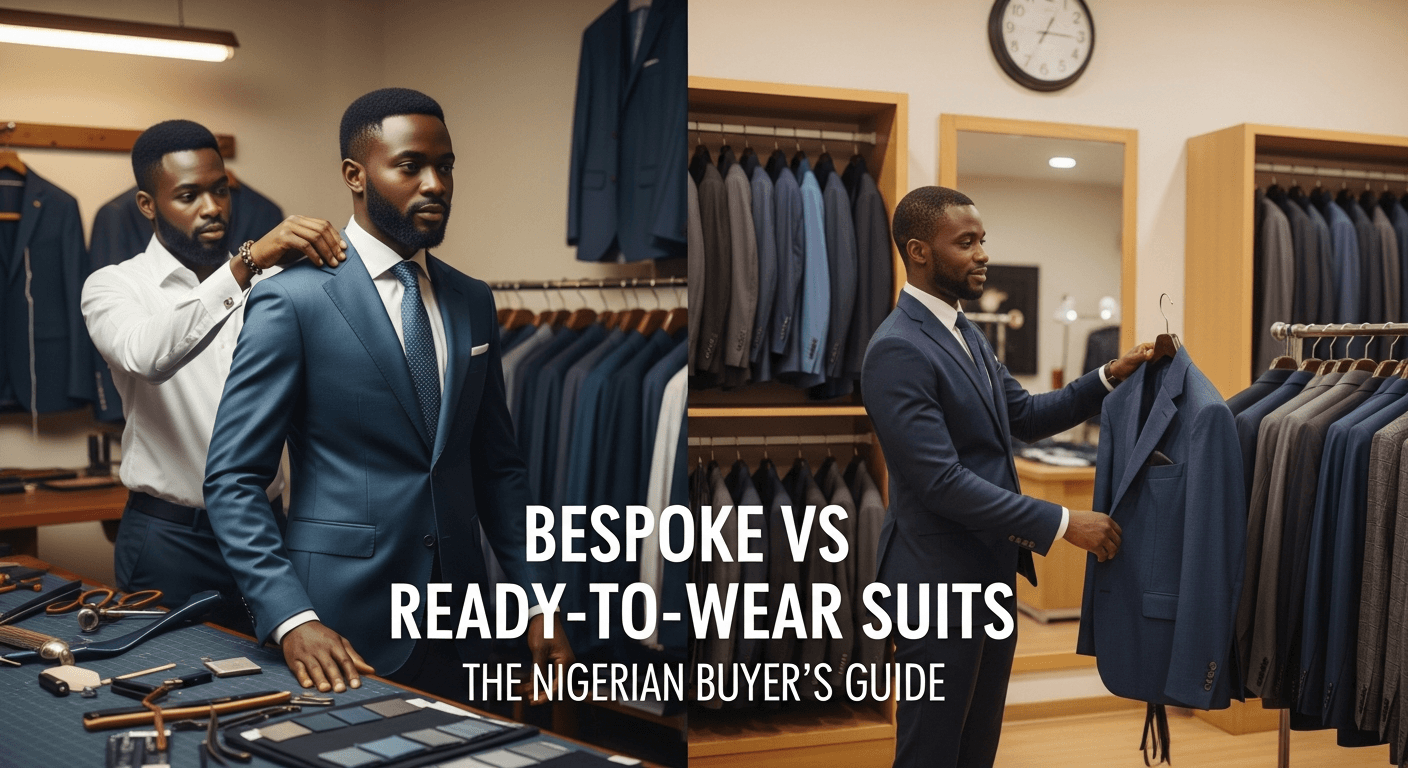
Bespoke vs. ready-to-wear suits in Nigeria: if you're a Lagos professional with a board presentation in three weeks and a WhatsApp thread open from a tailor quoting ₦220,000 alongside a browser tab showing a sharp option on suits.com.ng for ₦105,000, both figures look plausible. Neither label tells you what you're actually getting for the difference. That confusion is exactly where most Nigerian suit buyers get stuck, and it costs them money either way.
"Suits" in Nigeria span three genuinely different categories: ready-to-wear (RTW), made-to-measure (MTM), and full bespoke. Each category serves a different buyer, occasion, and budget. People use the terminology so loosely, especially in tailoring conversations, that many buyers don't realize they're comparing entirely different things. This guide clearly outlines those differences, using real pricing data, so you can make the best choice for your situation. Throughout, Vee Clothing Company, a premium Lagos-based tailoring house, serves as the concrete benchmark for what the upper end of bespoke genuinely looks like in the Nigerian market.
Bespoke, Made-to-Measure, and Ready-to-Wear: What These Terms Actually Mean
The most expensive mistake a suit buyer can make is paying bespoke prices for a made-to-measure process. The word “bespoke” is used loosely by tailors who don’t always mean the same thing by it, a documented risk in Nigeria’s tailoring market that surprises buyers. Before you spend a naira, make sure you understand the three categories.
What Ready-to-Wear Actually Is
RTW suits are manufactured in standardized sizes, designed to fit a broad range of body types adequately and nobody perfectly. In Nigeria, you'll find RTW suits in department stores, mid-range fashion retailers, and online platforms. What drives the price within RTW is fabric quality, whether the suit is locally produced or imported, and the brand behind it. The cost breakdown section below covers detailed pricing for both RTW and bespoke.
Made-to-Measure vs Bespoke: Not the Same Process
Made-to-measure starts with a pre-existing base pattern adjusted to your measurements. It's customized, but the foundation is not unique to you. True bespoke is a fundamentally different process: the pattern is drafted from scratch, specifically for your body. It involves multiple fittings, hand-cutting, and often hand-finishing, producing a garment with no equivalent in MTM or RTW. When a Nigerian tailor describes their service as "bespoke," ask directly whether they draft a unique pattern or adjust a base block. That answer tells you exactly what you're commissioning.
Bespoke vs. Ready-to-Wear Suits in Nigeria: The Real Cost Breakdown
Price ranges for suits in Nigeria vary widely, and most sources give figures too vague to act on. Below are grounded numbers across both categories, drawn from current market observations, so you can compare like for like.
What You Pay for Ready-to-Wear Suits in Nigerian Stores
Budget RTW suits in Nigeria start around ₦18,000, with decent mid-range options sitting between ₦48,000 and ₦120,000. Premium imported suits from online platforms can reach ₦195,000 to ₦205,000 for three-piece or embroidered styles. At the budget end, you're typically getting a polyester blend in a standard cut. At the premium RTW end, you're getting better fabric and finishing, but still a suit designed for an average body, not yours.
What Bespoke Tailoring in Lagos and Abuja Actually Costs
Lagos bespoke commissions from competent local tailors generally start in the ₦30,000 to ₦80,000 range, with the broader market spanning ₦100,000 to ₦300,000 depending on fabric quality and the tailor's standing. Premium bespoke work at established houses, those sourcing from quality global mills, can exceed ₦300,000 for a single commission. Abuja pricing typically runs 20 to 40 percent lower than Lagos across comparable service tiers. The framing that matters here is cost-per-wear: a well-constructed bespoke suit in a quality fabric, cared for properly, is built to last considerably longer than a budget RTW suit, which often loses its structure within two seasons. For additional market price context across Nigerian retailers, see a summary of current prices of men's suits in Nigeria.
Hidden Costs Buyers Often Miss
An RTW suit rarely leaves the hanger fitting correctly. Alterations, covering adjustments to the waist, sleeve length, trouser hem, or chest, add meaningfully to your total spend; factor these costs in before comparing RTW and bespoke on sticker price alone. More critically, alterations on RTW suits can only address surface-level fit. Professional tailoring widely recognizes that structural issues like shoulder width, chest suppression, or rise generally can’t be corrected without rebuilding the garment. A bespoke suit built to your body from the start completely sidesteps these issues. When you add alteration costs to a mid-range RTW purchase, the gap between RTW and entry-level bespoke narrows faster than most buyers expect. If you're trying to estimate final costs for custom work, resources that explain how much a custom suit costs can be useful as a cross-check.
Fit, Craftsmanship, and Longevity: Bespoke vs Ready-to-Wear Suits
RTW has legitimate uses, and an expensive RTW suit is not inherently a bad choice. But the honest comparison between these two routes matters; here's what it actually looks like across the dimensions that affect your daily experience of the garment.
Why Off-the-Rack Suits Rarely Fit Nigerian Body Types Straight Off the Hanger
RTW sizing is calibrated to generalized body proportions, and that data is often based on Western body-type measurements. Nigerian men show wide variation in shoulder width, chest-to-waist drop, arm length, and torso proportion that standard sizing addresses poorly. The result is a suit that fits in one area and compensates poorly in another. Even a ₦190,000 imported RTW suit will have this problem if your body doesn't match its base pattern. The fit problem is structural, not a matter of price.
Bespoke tailoring gives you access to a wider fabric range: lightweight worsted wools for boardroom wear, local textiles like Adire or Aso-oke for cultural and formal occasions, and premium blends suited to Nigeria's climate. Lightweight wool under 240gsm, counterintuitively, outperforms synthetic blends in breathability, drape, and lifespan even in tropical heat. RTW suits in the lower-to-mid price range rely heavily on polyester blends or thin cotton twill that wears out faster, creases more easily, and performs poorly in humidity. Fabric choice is where the long-term value difference between RTW and bespoke is most visible.
What a Real Bespoke Process Looks Like: The Vee Clothing Company Standard
Many Nigerian buyers have never experienced a genuine bespoke process, which makes it particularly challenging to evaluate what a tailor is actually offering. Here is what the process looks like at the upper end of the market.
The Consultation and Measurement Stage
At Vee Clothing Company, every commission begins with a private consultation, either in-person at their Lagos studio or virtually for clients in other states and the diaspora. The conversation covers lifestyle, occasions, silhouette preferences, color direction, and budget before anyone takes a single measurement. Measurements then cover more than a dozen reference points: chest, waist, seat, shoulder width, sleeve length, back length, rise, and others specific to the client's posture and proportions. This first stage alone distinguishes a true bespoke process from a tailor who takes chest and waist measurements and calls it done.
Fabric Selection: From Global Mills to Nigerian Heritage Textiles
Vee sources from premium global fabric mills, alongside locally sourced Nigerian Adire and Ghanaian Kente, for clients who want their garments to carry both world-class tailoring standards and African heritage. Fabric selection is guided by weight, drape, and appropriateness for the client's specific occasions, with swatches presented and explained in context. This level of fabric curation is simply not available at any RTW price point.
The Two-Fitting Process and What It Delivers
After the unique pattern is drafted and the canvas constructed, the client returns for a first fitting where structure, balance, and silhouette are assessed on the actual body. Adjustments are marked, made, and verified at a final fitting before the garment is completed. Vee Clothing Company operates on a two-fitting minimum because no amount of cutting-table skill replaces seeing a garment on the body it was made for. The result is a suit that moves with the wearer, not against them. Lead times for this process typically run four to eight weeks from consultation to delivery; if you need a detailed timeline for bespoke production, resources explaining how long it takes to make a bespoke suit provide useful benchmarks.
When Ready-to-Wear Is the Right Call
RTW makes sense when the occasion is infrequent, the budget is fixed, and the appearance stakes are relatively low. Legitimate RTW scenarios include an early-career professional building a starter wardrobe, someone needing a suit within 48 hours, or a buyer attending a one-off event where photography isn't a major factor. The key is choosing a retailer with a clear returns or exchange policy and factoring in basic alteration costs from the start. Buy the best fabric quality your budget allows; it will wear better and hold its shape longer.
When Bespoke Is the Smarter Long-Term Investment
Bespoke earns its premium when the suit will be worn repeatedly, when it will be photographed or filmed, when your body proportions make RTW a consistent fit problem, or when the garment functions as a professional status signal in high-stakes contexts. For Nigerian executives, C-suite leaders, and anyone building a personal brand alongside their business, "bespoke" is not an indulgence; it's a professional tool with a measurable return. The cost-per-wear calculation over a decade almost always favors a well-made bespoke suit over repeated RTW replacements.
The Quick Decision Checklist
Before you commit to either route, answer these five questions honestly:
- How often will you wear this suit in the next two years?
- Does your body type typically fit RTW suits off the hanger without significant alteration?
- Is this suit for a recurring professional context or a single occasion?
- What is your realistic total budget, including potential alteration costs?
- What do you need this suit to communicate about you to the people who will see you wearing it?
If your answers point toward frequent wear, a recurring professional context, a body that RTW doesn't serve well, and a garment that needs to communicate authority, the case for bespoke becomes clear on its own terms. If you're answering "once" and "low stakes" to most of these, a quality mid-range RTW suit with basic alterations is a perfectly sensible choice.
The Right Suit for the Right Purpose
Choosing between bespoke vs. ready-to-wear suits in Nigeria is not a question of which is objectively better. It's a question of what the suit needs to do, how often, and what result you're willing to invest in achieving. RTW has a clear and legitimate role in a modern Nigerian wardrobe, particularly for early-career professionals, single-occasion buyers, and anyone working within a tight timeframe. Bespoke, when done properly, operates in a different category entirely: fit, fabric, longevity, and the signal it sends are not replicable through any other process.
If you've worked through the checklist above and your answers point toward a genuine bespoke commission, the next step is finding a tailoring house whose process matches what the word "bespoke" actually requires. For recommendations on reputable local craftspeople and options to consider when searching for a tailor in Lagos, see the curated lists of the best tailors in Lagos.
Vee Clothing Company works with individuals and organizations across Lagos and Abuja, offering private in-person consultations at their Lagos studio and virtual appointments for clients across Nigeria and the diaspora. Their process, from fabric selection through the two-fitting standard, reflects what quality bespoke tailoring actually demands.
When you're weighing bespoke vs. ready-to-wear suits in Nigeria, the decision ultimately comes down to one question: what do you need this garment to do over its lifetime? A suit drafted for your body and built for the contexts that matter is an investment with a shelf life measured in decades, not seasons. Book a consultation with Vee Clothing Company to see what that process looks like in practice and leave with a clear understanding of whether it's the right next step for you.