
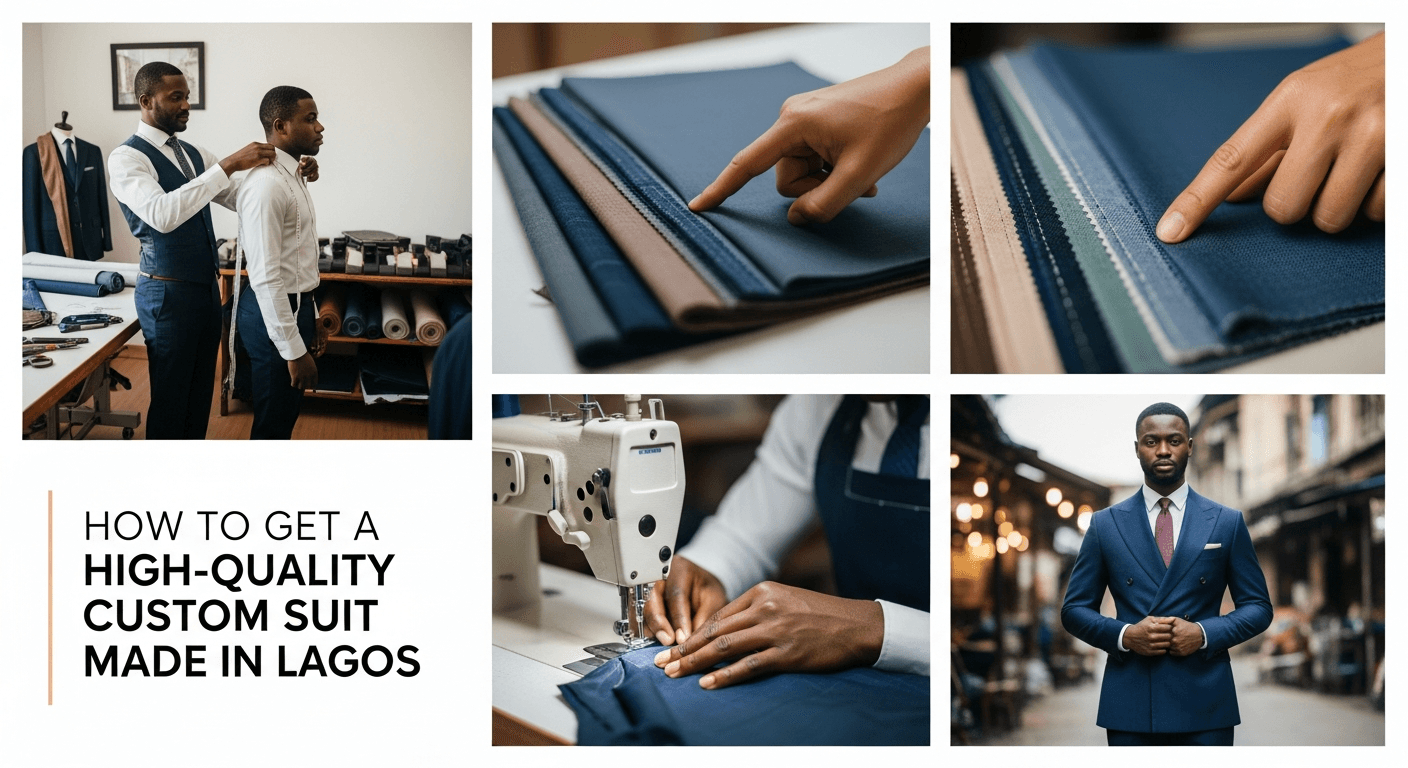
If you've ever asked yourself, where can I get a high-quality custom suit made in Lagos, you already know the frustration behind the question. You found a tailor with a beautiful Instagram page, paid a significant deposit, sat through one rushed measurement session, and collected a suit three weeks later that didn't fit across the shoulders, had lining puckering at the chest, and felt stiff as a cardboard box after one dry clean. It's a common story. But the problem isn't that quality tailoring doesn't exist in Lagos. The problem is that the word "bespoke" gets used so loosely it has become almost meaningless.
Lagos has a strong tier of craft-led tailors who operate with proper processes, premium fabrics, and the kind of structured fitting workflow that produces suits worth keeping for a decade. They sit alongside a much larger pool of fast-turnaround shops that produce custom clothing, but not bespoke clothing. The difference between these two categories is learnable, and once you understand it, you'll never waste money on the wrong tailor again. Houses like Vee Clothing Company have set a new standard in Lagos by applying structured fitting processes and sourcing fabrics from premium global mills, demonstrating that genuine bespoke menswear has real roots in this city.
This guide gives you the framework to find the right custom suit maker in Lagos, understand what you're paying for, and ask exactly the right questions before you commit a single naira.
What separates a real bespoke tailor in Lagos from the rest
Before you can evaluate any tailor, you need to understand what genuine bespoke tailoring actually looks like. The word gets stretched to cover everything from true pattern-to-body construction down to basic alterations on a standard size. Knowing the markers of real quality means you won't be fooled by good marketing.
Full canvas vs. fused construction: why it matters
Construction method is the single biggest quality indicator in a suit, and most buyers never ask about it. A full canvas suit uses a floating interlining sewn through the chest and front panels. This interlining moves with your body, breathes naturally, and improves with wear as it shapes to your specific torso over time. A fused suit uses glued layers instead, which feel stiff from day one, trap heat, and eventually bubble or separate, especially after dry cleaning in Lagos's humidity. For a deeper comparison of half- and full-canvas construction, see this half vs full canvas guide.
Many fast-turnaround tailors in Lagos default to fused construction because it cuts production time significantly. You can test for it yourself before committing. Pinch the front of the jacket between two fingers, holding the outer fabric and inner lining. If they move independently with a soft, layered feel, you're holding a canvas suit. If they move as one rigid piece with no give, it's fused. This pinch test takes ten seconds and will save you a great deal of money.
Bespoke vs. made-to-measure: knowing the difference
These two terms describe fundamentally different processes, and any tailor worth working with should be able to explain the difference clearly. True bespoke starts with a blank pattern created specifically for your body measurements, posture, and any asymmetries you carry. Made-to-measure starts with a standard-size block and adjusts it to fit closer to your measurements. Both have value, but they're not the same thing, and they don't produce the same result.
If you ask a tailor whether their service is bespoke or made-to-measure and they hesitate, deflect, or tell you "it's the same thing," that response tells you everything you need to know. A confident, knowledgeable tailor will answer the question directly and explain their process in detail.
Wool grades and what they mean for wearability
The "Super" grading system measures wool fiber fineness in microns. For premium everyday and boardroom suiting in Lagos, the relevant range sits between Super 100s and Super 130s. Super 100s offers thicker, more durable fibers that resist wear and wrinkling better, making it the stronger choice for suits you plan to wear frequently. Super 130s is finer, softer, and more refined in appearance, but it's more delicate and less forgiving in humid conditions if the suit isn't properly lined or cared for. Super 120s is generally the sweet spot for the Lagos climate: refined enough for executive suiting, durable enough for regular wear. For a concise primer on how Super Numbers affect fabric performance, consult this guide to Super Wool.
The more important question isn't the Super number alone; it's where the cloth came from. Ask any tailor which mill their fabric is sourced from. Mills like Holland & Sherry (British) and Dormeuil (French) are widely regarded in the tailoring industry as benchmarks for premium cloth quality and consistent grading. A tailor who can't name the mill, or who tells you the cloth is "imported" without specifics, is likely sourcing from ungraded market fabric. That's a serious warning sign.
African heritage fabrics worth knowing in suiting
Some premium Lagos tailors now integrate Nigerian Adire and Ghanaian Kente into bespoke commissions, not as a novelty, but as considered design choices. These fabrics appear as lining accents, pocket square complements, or, occasionally, as statement outer panels for ceremonial wear. When sourced properly and handled by a tailor who understands their weight and behavior, they add a layer of cultural authenticity that no imported cloth can replicate.
If this matters to you, ask directly whether the tailor has experience working with heritage textiles. The answer will tell you whether you're dealing with someone who has craft knowledge in this area or someone who will nod along and figure it out later at your expense.
Where can I get a high-quality custom suit made in Lagos? timelines and pricing
One of the most common mistakes What Lagos clients make is letting a tight event deadline push them into accepting a rushed job. Understanding realistic timelines before you start the conversation protects you from that trap.
Turnaround times by tailor tier
High-end bespoke tailors in Lagos typically work on timelines of six to eight weeks at a minimum. The design of this process includes multiple fittings, not courtesy. If a tailor at this tier offers to complete a true bespoke suit in two weeks, they must have cut corners somewhere. Mid-tier custom tailors, who generally operate on a made-to-measure rather than a full bespoke model, work within four to six weeks. Standard local tailors often promise two to four weeks, and speed is the primary selling point at that tier.
Factor in Lagos's peak tailoring seasons as well. Wedding season and year-end corporate events can push these timelines out further across all tiers, potentially by two to three weeks, based on how booked a given atelier is. If you have a fixed event date, work backwards from it and start the process earlier than feels necessary.
Price ranges for a quality bespoke suit in Lagos in 2026
A high-quality bespoke suit in Lagos in 2026, built on full canvas construction with premium wool from a named mill and proper hand finishing, typically sits in the range of ₦800,000 to ₦2,000,000. For reference, that is roughly $500 to $1,300 USD, though the naira-to-dollar rate fluctuates; confirm the current rate before budgeting in foreign currency. That range reflects real craft: measured, fitted, constructed, and finished correctly. Anything presented as full-canvas bespoke at significantly lower pricing is worth scrutinizing carefully before you commit to it.
Mid-tier made-to-measure can come in below that range, and for many clients, it offers a strong balance of quality and cost. Just be clear on what you are purchasing and ensure that the price reflects the actual process applied to your garment.
Where can I get a high-quality custom suit made in Lagos? reputable makers to consider:
Lagos has a handful of tailoring houses with credible craft credentials. These are worth shortlisting, but bring the questions in the next section to every conversation before booking.
Vee Clothing Company: structured bespoke process, African textile heritage
Vee Clothing Company is a Lagos-based tailoring house that applies a structured bespoke consultation model, moving clients through an initial measurement session and a forward fitting before final delivery. Their fabric offering spans premium imported wools through to Nigerian Adire and Ghanaian Kente, applied according to the client's brief. They serve both individual private clients and corporate accounts under the same construction standard. That consistency matters: the same process discipline that goes into a CEO's boardroom suit applies to a corporate uniform commission.
In a market where "bespoke" is often used loosely, Vee Clothing Company is a house that applies structured processes at both ends of the client spectrum. Their ability to serve private wardrobe clients and organizations needing branded apparel, without compromising on craft at either end, makes them a strong starting point for anyone serious about premium suiting in Lagos.
Questions to ask before you book your first fitting
These questions serve two purposes: they get you real, usable information, and they reveal how knowledgeable and confident the tailor actually is. Use them verbatim if you need to.
Construction and fabric questions
- Is this suit full canvas, half canvas, or fused?
- What mill does the fabric come from, and what is the wool weight in grams per meter?
- Can I see swatches or fabric samples before I commit to a cloth?
- Do you do any hand finishing, and where specifically on the garment?
A tailor who answers these confidently and in detail is demonstrating real craft knowledge. A tailor who deflects, gives vague answers, or seems irritated by the questions is showing you exactly the kind of experience you'll have when something goes wrong later.
Process, fittings, and aftercare questions
- How many fittings are included, and what does each fitting address specifically?
- What is the realistic turnaround time for my order starting today, not a best-case estimate?
- If alterations are needed after the final delivery, what does that process look like?
- Do you keep my pattern on file for future commissions?
That last question is worth special attention. A tailor who retains your pattern treats your relationship as ongoing. One who starts from scratch each time you return is a made-to-measure operation at best, regardless of what they call their service.
Finding a high-quality custom suit made in Lagos: it's more achievable than you think
Lagos has the craft, the fabric access, and the tailoring talent to produce suits of genuinely high quality. The challenge has never been availability. It's always been about knowing how to identify the real from the imitation before you've already paid.
Quality shows up in whether the tailor can be specific about construction, fabric sourcing, and fittings and whether they do so without prompting. A tailor who can answer every question in this guide with confidence and detail is worth your time and your investment. Someone who can’t do it is not a good candidate, regardless of how good the portfolio photos look.
If you want to shortcut the research process, Vee Clothing Company offers private in-person consultations in Lagos and applies a structured bespoke process to every client, whether you're commissioning a single boardroom suit or outfitting an entire corporate team. Reach out and book a consultation. Bring these questions with you. Good tailors welcome them.